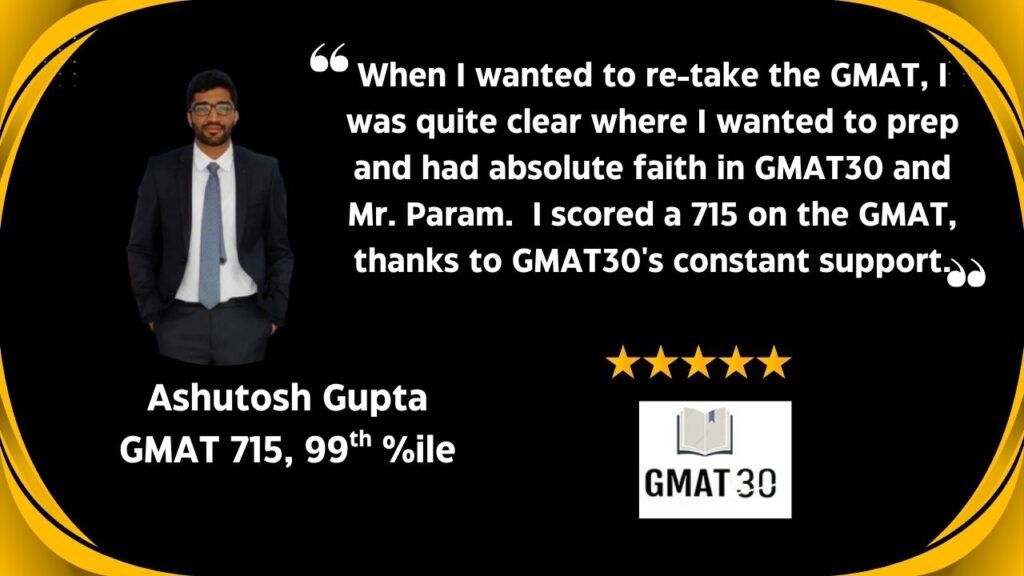

From UPSC Prep to GMAT 99th Percentile: How Ashutosh Mastered the New GMAT (715)
A computer scientist from VJTI (Veermata Jijabai Technological Institute) and a full-time working professional, Ashutosh’s path to the GMAT was anything but linear. He was simultaneously preparing for the UPSC Civil Services Examination while juggling his job responsibilities. Free time was a luxury, sustained focus a challenge. Yet, his goal was clear: to secure a competitive GMAT score (he was aiming for an 805!) and unlock global MBA opportunities.
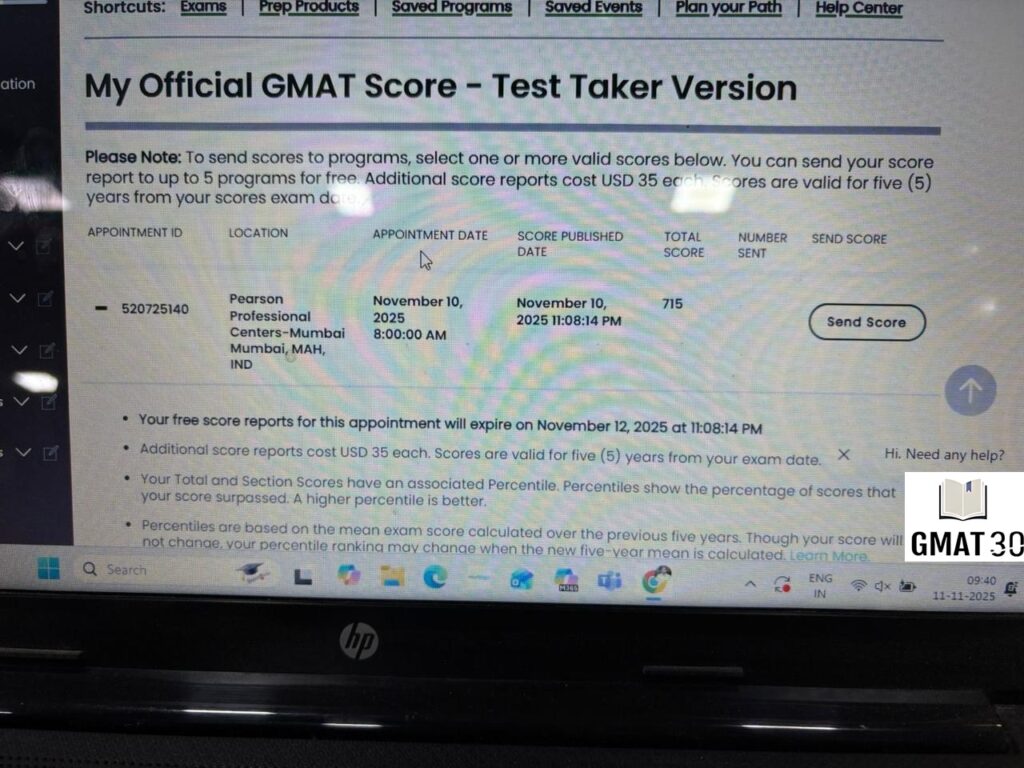
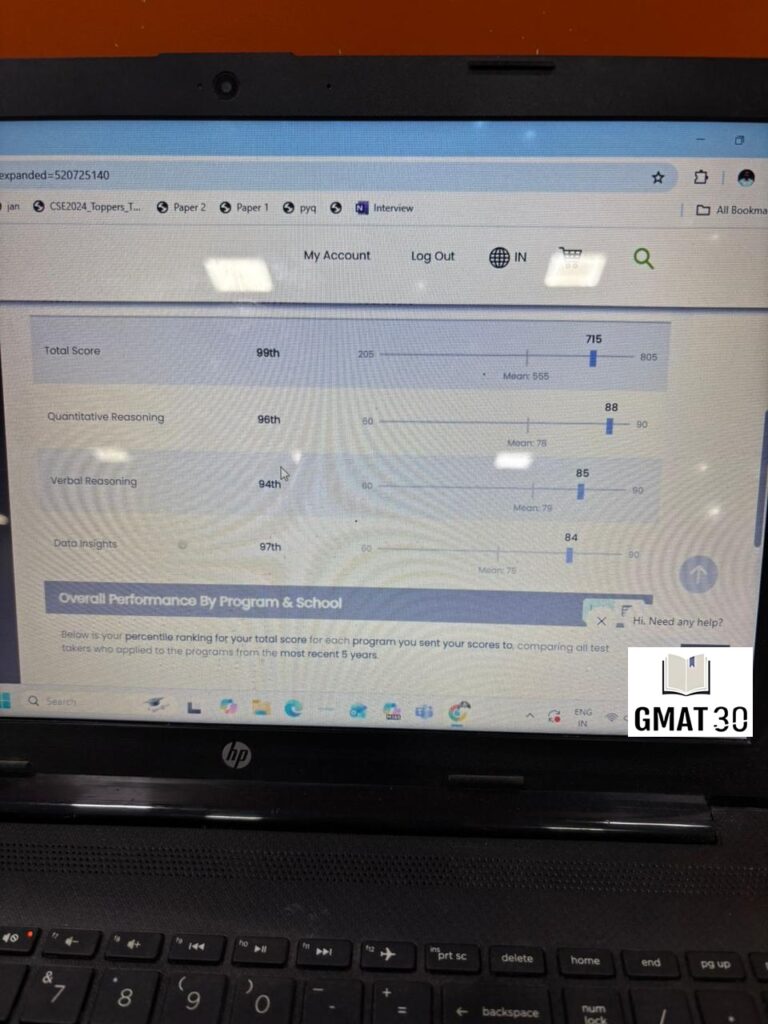
This is the story of how he did exactly that, scoring a 99th percentile (715) on the GMAT. He achieved an outstanding 97th percentile in Data Insights, 96th percentile in Quant, and 94th percentile in GMAT Verbal. His performance was equally superlative across the 3 sections, which speaks volumes about the depth of his conceptual mastery. We will also understand how Ashutosh leveraged GMAT30’s academic ecosystem to bolster his prep, particularly in the Verbal and DI sections.
GMAT Beginnings: A Strong Quant Foundation
When Ashutosh joined GMAT30 earlier this year, he had already written the GMAT once (in 2020) with a score of 730 (96th percentile). He had secured a perfect score in the Quant section (Q51 on the classic edition). However, like many Indian GMAT aspirants, his Verbal percentile of 85th is something that he wanted to improve. He was also not completely sure about the relatively unknown Data Insights section (the older GMAT didn’t have a DI section). To work on these weaknesses in a targeted manner, Ashutosh joined our Weekend program.
In Verbal, he faced problems with GMAT-style frameworks, especially in the inference and assumption questions. He also had difficulty with advanced-level boldfaced, causation-correlation, and conditional statement frameworks. His gaps were a mix of both content and strategy. In Data Insights, Ashutosh struggled with managing his time, especially in the MSR questions.
Mastering GMAT Verbal
Ashutosh went about improving his GMAT Verbal systematically. He attended each lecture, solved the assignment sets pertaining to that particular lecture, and used our live doubt-solving to have his queries resolved. This structured approach facilitated his learning of concepts in an organic manner. He also solved additional advanced questions from GMATClub, specifically LSAT and 1000 Series passages for RCs. This helped him become more proficient at tackling advanced concepts and passages. He would practice exclusively GMAT 99th percentile 705-805 and 805+ level questions from our assignments, and from the above-mentioned filtered lists on GMATClub. Any doubts would be resolved through our live doubt-solving (we have a turnaround time of ~30-40 mins).
Tackling GMAT Data Insights
In the Data Insights section, Ashutosh focused on quality over quantity. As there is a paucity of official content on Data Insights, Ashutosh relied exclusively on the GMAT30 Assignment sets, the official Data Insights Review, and the questions from the 15 Experts’ Global mocks (provided as part of the course). In the final 20 days leading up to his exam, he would write and analyze a mock on almost a daily basis. This work ethic speaks volumes about his determination to score a GMAT 100th %ile.
Overall, he practiced such that he was able to solve a Data Sufficiency question within 1-1.5 mins, thereby allowing him to invest additional time in the more time-consuming MSR and TPA questions. During mocks, a strategy that Ashutosh would employ would often involve skipping an MSR question set entirely, coming back to it only during review.
Understanding GMAT Algo & Leveraging GMAT30 Frameworks
The GMAT algorithm rewards:
Quick responses to medium, medium-hard, and hard-medium level questions
Minimal errors on easy questions
Acceptable errors on the harder questions
Ashutosh understood this idea quicker than most. The idea that the algorithm would consider a test taker an “expert” if they can solve a difficult question correctly within a minute or less. He also understood that the algorithm would then allow a bit more flexibility in the overall accuracy. He focused less on “getting everything right” and more on getting the right things right. More on that here.
He tightened his Verbal fundamentals using GMAT30’s frameworks for:
RC S.C.O.R.E methodology of skim reading and main point analysis
CR mathematical and logical frameworks
Process of elimination-based decision-making under time pressure
Ashutosh also didn’t underestimate the importance of Verbal DI in his bid to secure a 99th percentile. He treated Verbal DI as a strategic scoring lever. Through deliberate practice and repeated mock reviews, he learned how to handle:
Table and Graph questions within 2 mins
DS questions within 1 min
Smart use of the Review Feature to manage timing
Final GMAT Analysis
By the time he completed his test, his DI percentile had soared to 97. That pushed his composite to 715, placing him in the 99th percentile overall. The efficiency in the DS questions (Ashutosh solved some questions in as little as 30 seconds, and others within 1-1.5 minutes) was also rewarded in the final sectional score. Despite 6 errors in the section, Ashutosh was able to secure an extremely impressive percentile score in DI.
The final ESR breakdown showed:
12 total incorrect answers across all sections
94th percentile+ in every section
Remarkable consistency in timed performance
This combination of stability, speed, and accuracy is exactly what the GMAT algorithm rewards.
What Makes Ashutosh’s Journey Stand Out
Ashutosh wasn’t a full-time student with unlimited hours. He wasn’t someone solving 200 questions a day. Neither was he someone who took months off from work to prep for the GMAT.
Rather, he was:
A working professional
Preparing for two demanding exams, with limited time but immense commitment, and
Willing to learn the right way, not the loud way
That’s what makes his 715 truly special. His path proves a truth that many GMAT aspirants forget:
You don’t need endless time; you need the right structure and unwavering consistency.
Ashutosh’s Advice to GMAT Aspirants
During our fireside chat, Ashutosh summed it up perfectly:
“You don’t need to study 6 hours a day to score the 99th percentile on the GMAT. Study the right way for the time you have. Consistency is key.
Studying 2-3 hours daily in a concentrated manner is better than trying to cram everything over the weekends. For me, I used to wake up 2 hours earlier every weekday to ensure that I could spend that time on GMAT prep when my mind was at its freshest”
This dedication and mindset alone deserves a 100th percentile score. Although he fell short of his target by 1% percentile, we hope this advice can motivate students to replicate Ashutosh’s journey and ace their GMAT preparation.
Are you ready to start your GMAT success story? At GMAT30, we’re here to help you unlock your full potential. Reach out today to see how we can help you achieve your goals.