

Hi All,
I want to share an experience from one of my GMAT attempts, where I scored a perfect V90 (100th percentile) on GMAT Verbal, and more importantly, what that experience reinforces about how the Verbal section of the GMAT can be conquered.
I wanted to share this debrief because while most students I speak to feel confident in Quant, and to a lesser extent, the Data Insights section, GMAT Verbal is something that at least 70% of my students find challenging. They feel that being non-native speakers of the language gives them a distinct disadvantage. Hopefully, this debrief can quell some of those fears, and help you conquer GMAT Verbal with confidence.
Section Order
With great flexibility, comes great responsibility! An aspirant needs to work out the section order that would give them the best chances of maximizing their score. Although it is possible to choose any of the 6 combinations, I personally believe that it is not the wisest to start or end with the Data Insights (DI) section. I elaborate on this later.
My section order in my GMAT (Focus) attempts has been Quant, DI, break, and Verbal. It was the same here. The rationale for this was that I didn’t want DI to be either the first or the last section. At the very beginning, post the palm scanning and passport check, I didn’t think I would be mentally warmed up enough to analyse the volume of data presented in DI. Similarly, I wouldn’t want fatigue to set in after sitting through the test for 1.5 hours+. Hence, DI had to be sandwiched in the middle – this is the same advice I provide to our students as well.
I also believe it’s better to have Quant and DI go hand in hand, since the % of Non-Math Related questions in the DI section is quite small (and has been over the past 1.5 years at least). I also agree with many other instructors I have spoken to that the GMAC has probably made the DI section much harder than it need be – a feedback I have shared with the folks at GMAC. Anyway, that’s a story for another day..
How I Prep(ped) For the GMAT
As an instructor who has been teaching the GMAT for 10+ years, it can be quite challenging to find new, authentic GMAT-like questions to practice. This is because I had come across most of the official questions, including the mocks, either during my teaching or content refinement. However, there is a great place where you can get access to virtually unlimited (new questions are uploaded daily) GMAT-like questions, at least for Quant and Verbal.
For my own GMAT prep, I always use questions from GMATClub, setting source filter to 1000CR, LSAT, OG, QR, VR, DI Review. This forum always has new questions, and given that official questions are mostly familiar to me (by dint of teaching for the GMAT for 10+ years), this is the only place where I can find good, new questions. I also used ~3-4 GMATClub full-length tests, which are among the best out there. This is because, again, official mock questions and Experts’ Global mocks (which we share with our students) are quite familiar to me.
GMAT Verbal: An Advantage for Native Speakers? No!
In theory, for many candidates, especially engineers, Quant comes naturally. By extension, Data Insights, which is two-thirds Quant and associated concepts like Stats, Ratios, Sets, etc., also feels manageable. But Verbal? That’s often the section that quietly holds people back from breaking into the 98th percentile and beyond.
Being a non-native English speaker adds another mental layer. There’s a persistent belief that Verbal success requires exceptional fluency, a love for reading, or some innate linguistic advantage. In my experience, that belief is not correct.
Writing the GMAT every year or 15 months helps us track changing question styles and difficulty, understand topic weightage, and observe how adaptivity actually plays out. For example, there has been some discussion on forums regarding the section-adaptive nature of the GMAT. From my experiences, I can say that the “section adaptive” part may be a little exaggerated. I didn’t find much difference in terms of the overall difficulty of the DI section in my attempts. The same goes for the Verbal section. Whatever fluctuation in score, it could be put down to a lapse of concentration/fatigue.
You Don’t Need 100% Accuracy for a V90
One important misconception to clear right away: Unlike Quant, Verbal does not require perfection to score perfectly.
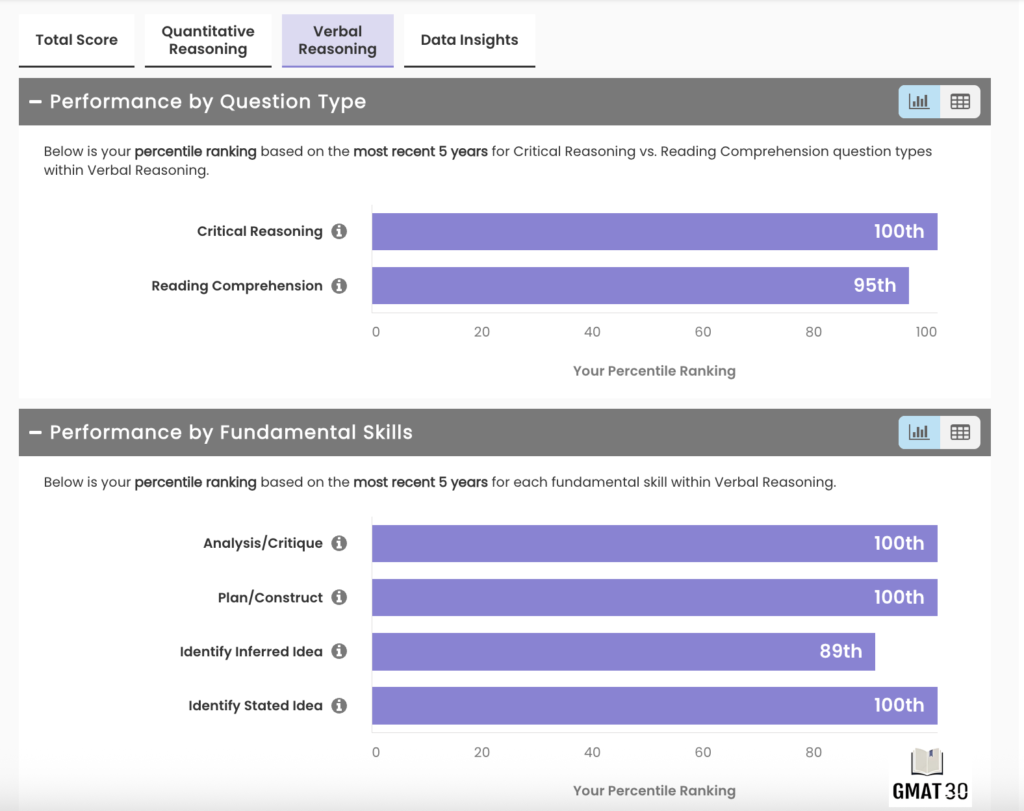
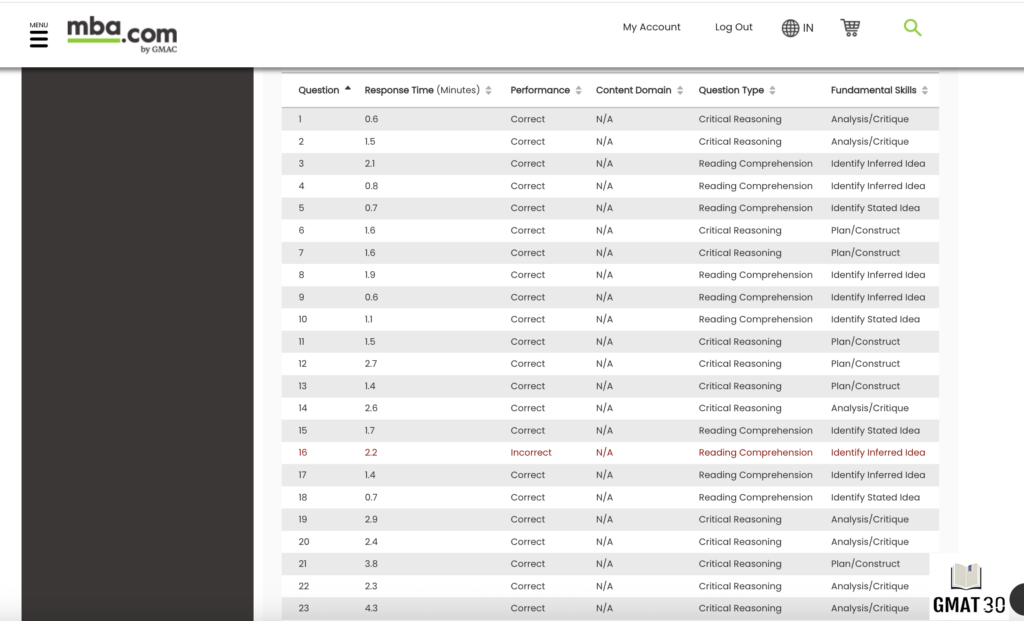
In the ESR from this attempt, I actually got one scored question wrong (reflected by a slightly lower RC percentile). On top of that, each section contains experimental questions that do not count toward your score. Hypothetically, if you answer the scored questions correctly, an accuracy of 21/23 could still be enough for a 100th percentile Verbal score. This margin simply does not exist in Quant, where scoring is far more unforgiving (so far, I have not seen one ESR where a candidate has received a Q90 with one error).
That difference is important in how we can approach Verbal. DI, although much harder, is even more lenient. It is possible to score a 98th%ile on the DI section with as many as 4-5 errors [provided those are not early on and we don’t leave any questions unanswered].
GMAT Verbal Question Types and Strategies
The Verbal section comprises two broad question categories – Critical Reasoning (~11-13 questions), and Reading Comprehension (~10-13 questions). Critical Reasoning is often the biggest surprise for engineers, in a good way.
When approached systematically, CR aligns extremely well with logical and structured thinking. In my attempts, I rarely encountered a CR question where the framework-based approach didn’t work. The logic is testable, repeatable, and learnable, very much in line with how we teach CR at GMAT30. Nothing is tested beyond the standard (and advanced) frameworks such as causation-correlation, conditionals, reported vs actual data, and so on.
For Reading Comprehension (RC), I encountered 3 passages, which seems to be the new standard, with 1 long passage. RC is less about “reading everything” and more about reading with intent. I followed the S.C.O.R.E methodology, which we also teach our students at GMAT30. The core aspects of this strategy focus on:
- Skim reading (not line-by-line decoding)
- Understanding the author’s purpose
- Identifying the other side or counterview
- Tracking the relationship between viewpoints
Time Management on GMAT Verbal: A Game Changer
Time management is critical here. If you’re scoring well, it goes without saying you will see at least one ultra-long passage. The trap is spending too much time trying to understand every sentence and spiraling into confusion. The goal is clarity of structure, not completeness of detail. I spent no more than 1.3-1.5 minutes on an RC question throughout the test. Needless to say, I cannot, from either this attempt, or my previous attempts, recall much of any RC (unlike a CR/Quant/DI question). But that’s sort of the point: you don’t need to remember or fully understand the passage. Once the question set is over, the understanding of the passage can disappear too!
Across the GMAT, a simple principle holds true: Buy time early so you can spend it when it matters. Ideally:
- Spend <1.5 minutes per question on the first 8–10 questions (As you can see from the ESR images below, I spent ~12.5 minutes on the first 10 questions, with ~1.5 mins per RC question).
- Medium and medium-intermediate questions should be solved with ~90% accuracy in ~1 minute. This is particularly true if you’re aiming for a high score.
How to Deal with GMAT 805+ level Questions
Because the GMAT is adaptive, strong performance early means you’ll face harder, trickier questions later. In this attempt, for example, Verbal questions from Q21–Q23 required significantly more time (3.5-4 minutes) to correctly decide between two close options. Had I not had that time left (I had ~10 minutes left for the final 2 questions in Verbal) , I would have probably gotten at least 1-2 of those 3 questions incorrect. Not that the questions were “harder” – they tested the usual frameworks of Causation-Correlation, Actual vs Reported Data, etc, but the options were worded tremendously indirectly.
The same pattern appears in Quant and DI as well: a word problem, graph, or conversion that simply doesn’t “click” immediately. Your time strategy needs to allow for that.
Role of Good luck and (Good) Rest
Finally, no honest GMAT discussion is complete without acknowledging this: You do need a bit of luck on test day.
Sometimes the small things go your way. Sometimes they don’t. Occasionally, the correct answer turns out to be the option you ruled out after 3.5+ minutes of internal (eternal) debate. That said, you also make your own luck – through preparation, repetition, and clarity of process
And please don’t underestimate this: being well-rested matters. Especially in Verbal and Data Insights, fatigue clouds your ability to see logical gaps, infer conclusions, see patterns in data, or extract the author’s main point from a dense passage.
So, What Does It Take to Score a V90? Structure. Practice. And a bit of luck.
Have faith in the process, and you’ll get there.
Happy prepping!
My GMAT Classic Debrief
Verified GMATClub Score(s) and Debrief: https://gmatclub.com/forum/perfect-v90-100-ile-score-test-centre-debrief-454027.html fi







One Response