
Humble Beginnings: Many Questions
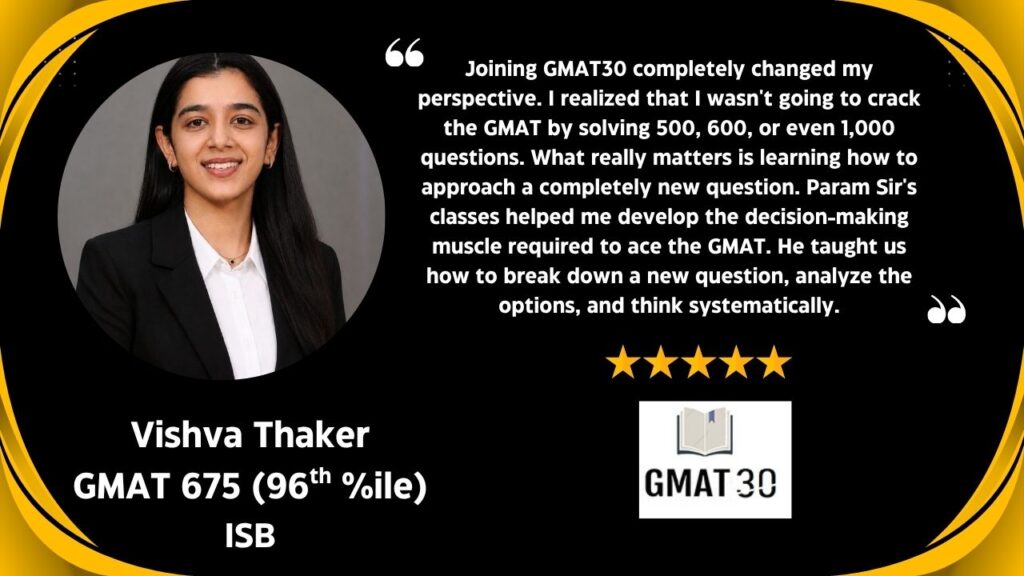
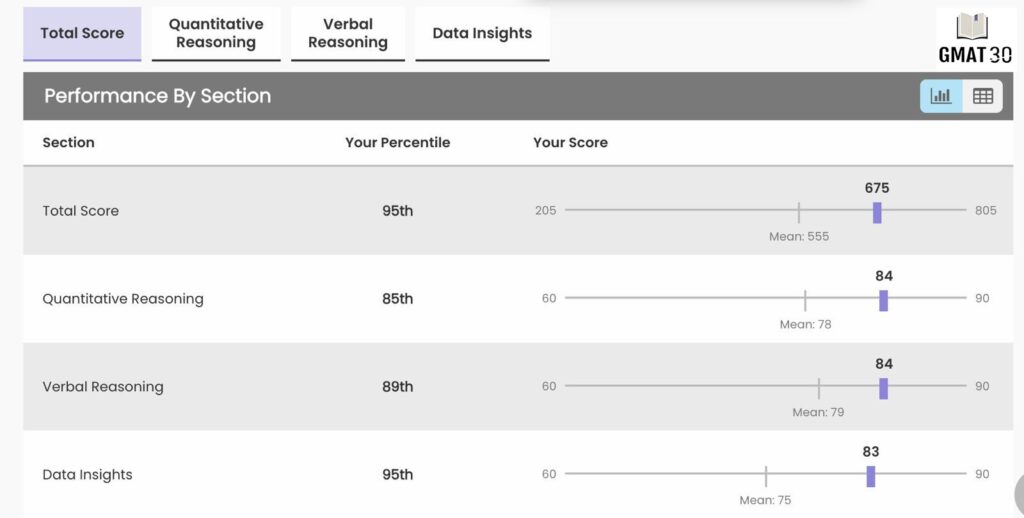
“I had solved 200 GMAT Verbal Questions when I joined GMAT30. I still couldn’t solve a new one.” – Vishva Thaker (GMAT 675, 95th%ile)
One of the biggest misconceptions in GMAT preparation is that success comes from solving more questions. When students struggle with GMAT Verbal, the natural reaction is to practice harder. Solve another 100 questions. Then another 200. Buy another question bank. Watch another YouTube video.
But what if the problem isn’t the number of questions you’ve solved?
What if the problem is how you’re approaching them?
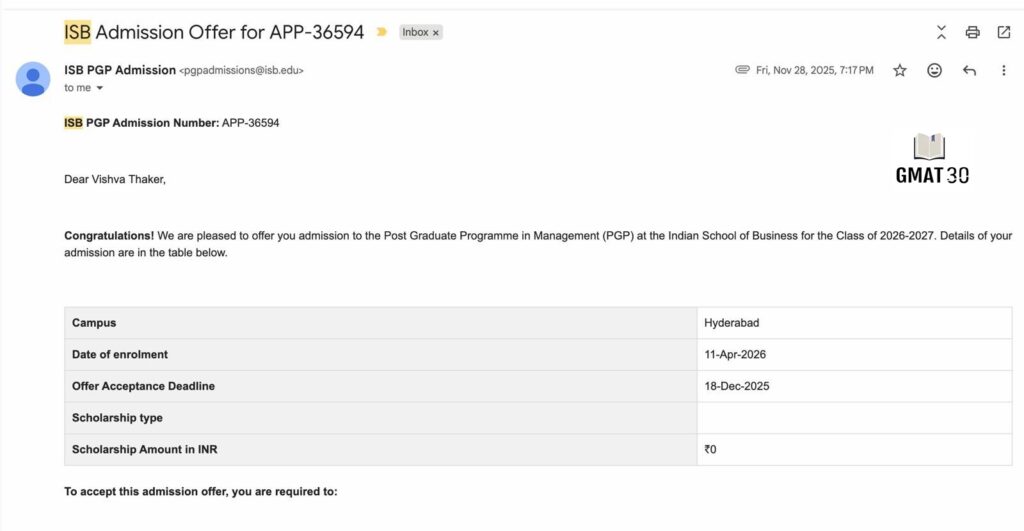
This is the story of Vishva Thaker, a GMAT30 student who eventually secured admission to the prestigious Indian School of Business (ISB).
The Problem: The Process is Punishment
Before joining GMAT30, Vishva had already solved nearly 200 GMAT Verbal questions.
For most students, that sounds like a significant amount of preparation. Yet she found herself facing the same problem repeatedly. Every new question felt unfamiliar. Every difficult question would leave her stuck between two or three answer choices. She could often eliminate some options, but she couldn’t confidently determine which remaining choice was actually correct.
In her words:
“I would always get stuck at the last two or three options, and I was not able to filter out those options and understand which one was actually right.”
This is a situation we see frequently – students believe they have a knowledge gap when, in reality, they have a process gap.
The Realization That Changed Everything
At one point during her preparation journey, Vishva spoke to a professor on LinkedIn who recommended that she explore coaching with GMAT30.
After joining our program, she quickly realized something important. The solution wasn’t going to be just solving another 500 or 1,000 questions. The solution was learning how to approach a completely new question.
After all, every question on the actual GMAT is new. No matter how many questions you’ve solved during preparation, you’ll inevitably face fresh questions under significant time pressure on test day. The challenge isn’t recognition; the challenge is reasoning.
As Vishva puts it:
“What is really important is how you internalize the framework-based approach of solving a new question because no matter how many questions you practice, you will always see a new question during your actual GMAT exam.”
That insight became the turning point in her preparation.
Building Muscle Memory
At GMAT30, we often tell students that the GMAT is not a test of memory: it is a test of decision-making. High scorers don’t succeed because they’ve seen every question type. They succeed because they’ve developed frameworks that allow them to analyze unfamiliar questions quickly and accurately.
For Vishva, this meant learning:
- How to break down a new Critical Reasoning question via frameworks
- How to identify the structure of an argument mathematically
- How to evaluate answer choices systematically
- How to avoid common GMAT traps
- How to make confident decisions under time pressure
Most importantly, she developed what she described as “muscle memory” for the GMAT. In layman’s terms, this refers to the ability to apply a repeatable process regardless of the question asked. This is the foundation of every elite GMAT score.
Beyond the Classroom: The GMAT30 Community Advantage
Preparation doesn’t end when class ends. One aspect of GMAT30 that Vishva found particularly valuable was our active doubt-solving ecosystem.
Months after completing her coaching, she continued to receive support from our team and community. Through our WhatsApp groups, students, alumni, mentors, and instructors collaborate daily to answer questions and discuss concepts. Any doubts would be resolved with a turnaround time of ~30-40 mins. This creates an environment where learning becomes continuous rather than transactional.
According to Vishva:
“Even months after my coaching, whenever I posted a query, they were very quick to respond.”
She also highlighted how reading other students’ doubts accelerated her own learning. Many students underestimate the value of collaborative learning. Often, the question you didn’t think to ask is exactly the one that helps unlock your next breakthrough.
The Outcome: An Admit to ISB
Like many ambitious professionals, Vishva had her sights set on top business schools.
The GMAT was an important milestone on that journey.
By focusing on process instead of merely accumulating practice questions, she was able to develop the reasoning skills necessary to perform at a higher level.
That preparation ultimately helped her strengthen her MBA application and secure admission to the Indian School of Business (ISB), one of the most selective and prestigious business schools in Asia.
The Lesson for GMAT Aspirants
If you’re currently preparing for the GMAT, ask yourself a simple question:
Are you collecting questions? Or are you building frameworks?
The difference matters.
One approach creates the illusion of progress. The other creates actual progress.
As Vishva discovered, solving hundreds of questions is not enough if you don’t know how to think through a new one.
The goal should be to develop the reasoning frameworks that allow you to tackle any question you encounter on test day.
Because the students who succeed on the GMAT aren’t necessarily the ones who have solved the most questions. They’re the ones who know exactly what to do when they see a question they’ve never seen before.
Thinking About Your Own GMAT Journey?
If you’re struggling with GMAT Verbal, stuck between answer choices, or feeling like endless practice isn’t translating into score improvement, it may be time to rethink your approach.
Your next breakthrough might not come from solving more questions. It might come from learning how to solve them differently.
Are you ready to start your GMAT success story? At GMAT30, we’re here to help you unlock your full potential. Reach out today to see how we can help you achieve your goals.